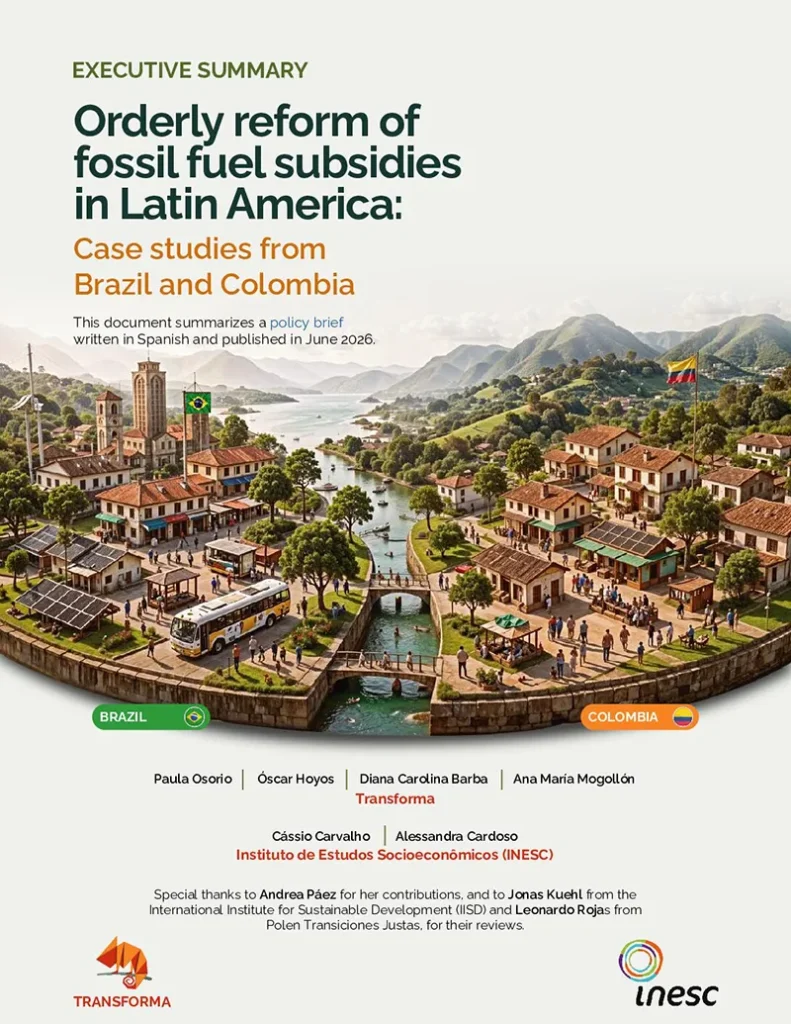
An orderly reform of fossil fuel subsidies makes it possible to distinguish which existing subsidies can be reformed quickly, which require compensation measures, and which should be maintained temporarily to meet energy-access objectives. The analysis of the cases of Brazil and Colombia links this prioritization to the possibility of redirecting resources toward fiscal sustainability and a just energy transition.
The executive summary of a policy brief written in Spanish, developed by Transforma and the Institute for Socioeconomic Studies (INESC), includes indicative inventories, prioritizes subsidies according to reform urgency, and examines concrete implementation opportunities in both countries. The approach connects three decisions: improving the information available, using regulatory windows to reform inefficient subsidies, and directing resources toward a just energy transition with targeting and social protection criteria.
Key recommendations
From the broader set of proposals, three directions stand out for advancing an orderly reform:
- Build comprehensive, public national inventories to quantify the total cost of subsidies and establish a common basis for reform. The priority is to standardize methodologies, definitions, and data, especially where tax benefits remain unobservable in public records.
- Differentiate among quick, gradual, and deferred reform pathways. Urgency increases where fiscal costs are high, targeting is weak, or future fiscal risks are greater; subsidies essential to basic energy access should be periodically reassessed.
- Freed-up resources can support fiscal sustainability and a just energy transition. In Colombia, the publication prioritizes mechanisms directed to renewable energies and higher energy reliability in non-interconnected populations; in Brazil, community distributed generation, storage, and the decarbonization of energy-intensive sectors.
Read the full publication to explore the Brazil and Colombia inventories, the prioritized subsidies, and the options for reform and resource reallocation.
Resources freed up by the reform of fossil fuel subsidies should contribute to the country’s fiscal sustainability and support a just energy transition.
How to cite the document
Osorio, P., Hoyos, Ó., Barba, D. C., Mogollón, A. M., Carvalho, C., & Cardoso, A. (n.d.). Orderly reform of fossil fuel subsidies in Latin America: Case studies from Brazil and Colombia [Executive summary].
Deciding which fossil fuel subsidies to reform, at what pace, and where to redirect public resources can turn a fiscal decision into a lever for a just energy transition, an approach consistent with Transforma’s commitment to aligning finance with a just and resilient climate transition.

Guiding reform and the use of resources
Under Transforma’s programmatic priority, “Finance aligned with a just and resilient climate transition,” fossil fuel subsidy reform can be guided by better information, prioritization, and the strategic use of public resources. The publication proposes:
- Build public inventories and common methodologies to quantify costs, improve data visibility, and establish a solid basis for prioritizing reforms.
- Apply gradual reforms where compensation measures or deep regulatory changes are required, and periodically reassess support that remains essential for basic energy access.
- Redirect freed-up resources toward efficient mechanisms: directed to renewable energies and higher energy reliability in non-interconnected populations in Colombia; community distributed generation, storage, and decarbonization of energy-intensive sectors in Brazil.
Moving in this direction could help align fiscal decisions with a more just transition in Latin America, while accounting for both the efficiency of public resources and their social and energy-access implications.