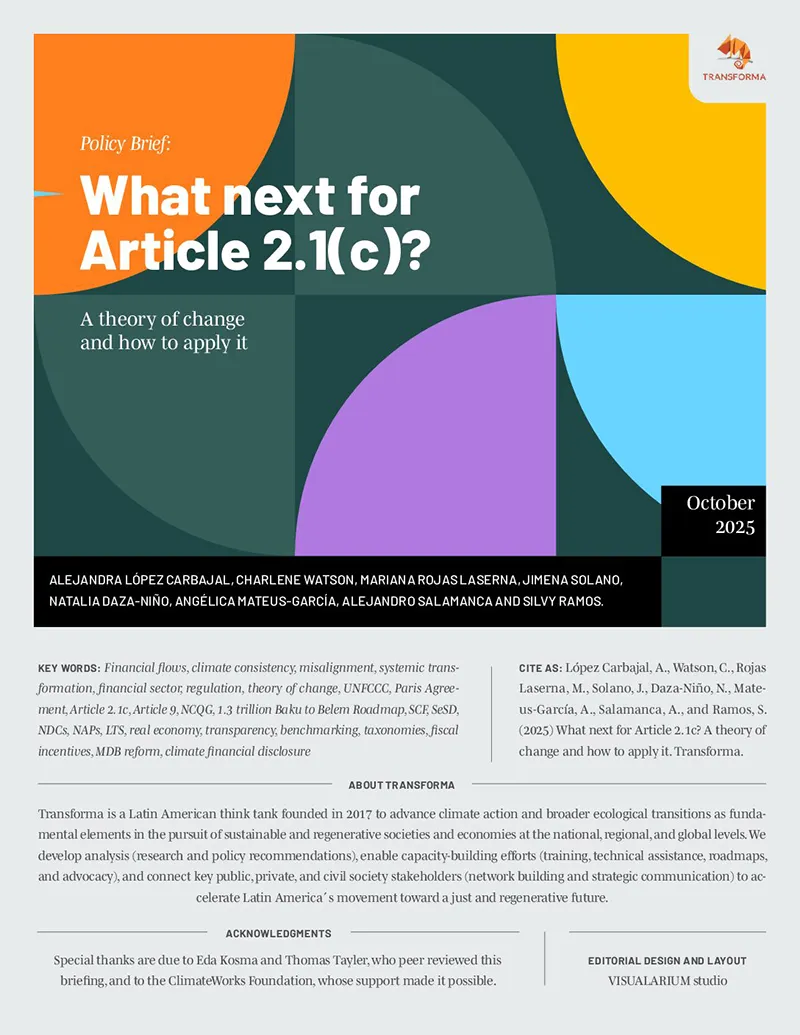
Article 2.1(c) of the Paris Agreement on climate change establishes one of its three long-term goals: to make financial flows consistent with low-emission, climate-resilient development. However, the lack of a shared vision of how to put it into practice makes it difficult to translate that goal into concrete action.
To address this gap, Transforma proposes a theory of change linking goals, outcomes, outputs and activities, so that governments, regulators, financial institutions and other stakeholders can identify their responsibilities and coordinate interventions. The proposal also underscores the importance of pursuing the transformation of the financial system envisaged under Article 2.1(c) in a way that complements Article 9 of the same Agreement, which establishes developed countries’ obligations to provide and mobilize climate finance for developing countries.
The theory identifies four outcomes that could guide this work: scaling up finance for low-emission, climate-resilient development; gradually phasing down financial flows that run counter to those pathways; facilitating fair and just transitions in developing countries; and expanding countries’ and economic sectors’ participation in financial markets and access to finance. In this way, the debate could move beyond an inventory of initiatives towards clearer decisions on which changes to pursue, who should be involved and how to track their contributions.
Key considerations
- Establish a multilateral framework driven by a theory of change that links goals, outcomes, outputs and activities. The framework would guide financial stakeholders on how to make their operations and decision-making consistent with climate goals, highlight the differentiated responsibilities of developed and developing countries, and identify interventions without duplicating mandates.
- Embed national action on Article 2.1(c) in nationally determined contributions, long-term strategies and adaptation plans, linking it to budgetary, regulatory and supervisory benchmarks to accelerate capital flows.
- Safeguard complementarity with Article 9: aligning financial flows does not replace developed countries’ obligations to provide and mobilize climate finance. The process must recognize countries’ differing capacities and circumstances.
Read the full policy brief to explore the proposed outcomes, how the theory of change can be applied and its implications for climate negotiations.
This establishes finance not only as an enabler of climate action but also as a domain that must itself undergo transformation
How to cite the document
López Carbajal, A., Watson, C., Rojas Laserna, M., Solano, J., Daza-Niño, N., Mateus-García, A., Salamanca, A., & Ramos, S. (2025). What next for Article 2.1(c)? A theory of change and how to apply it. Transforma.
Transforming the financial system requires more than mobilizing resources for climate action: it also entails changing the rules and decisions that steer capital. A theory of change can help coordinate these reforms and clarify responsibilities, an approach that aligns with Transforma’s programmatic priority of “Finance aligned with a just and resilient climate transition.”

From climate commitments to financial decisions
For Transforma’s programmatic priority of “Finance aligned with a just and resilient climate transition,” it is essential that climate goals inform decisions on how capital is regulated and allocated. The brief’s conclusions set out four lines of action to move in this direction:
- Establish a common framework: use a theory of change to connect financial initiatives with international climate processes, clarify each actor’s responsibilities and avoid duplication across institutions.
- Assess financial progress: link sectoral climate targets to the second Global Stocktake, which assesses collective progress, to measure whether financial flows are helping to achieve those targets.
- Integrate climate planning: link national commitments, long-term strategies and adaptation plans to budgets, regulation and supervision to steer investments towards activities consistent with climate goals.
- Safeguard climate finance obligations: ensure that financial system transformation does not replace developed countries’ duty to provide and mobilize resources to support a just climate transition in developing countries.
Progress on these lines of action could help the region make financial decisions that are more consistent with climate goals, while recognizing countries’ differing capacities and the importance of a just and resilient transition.