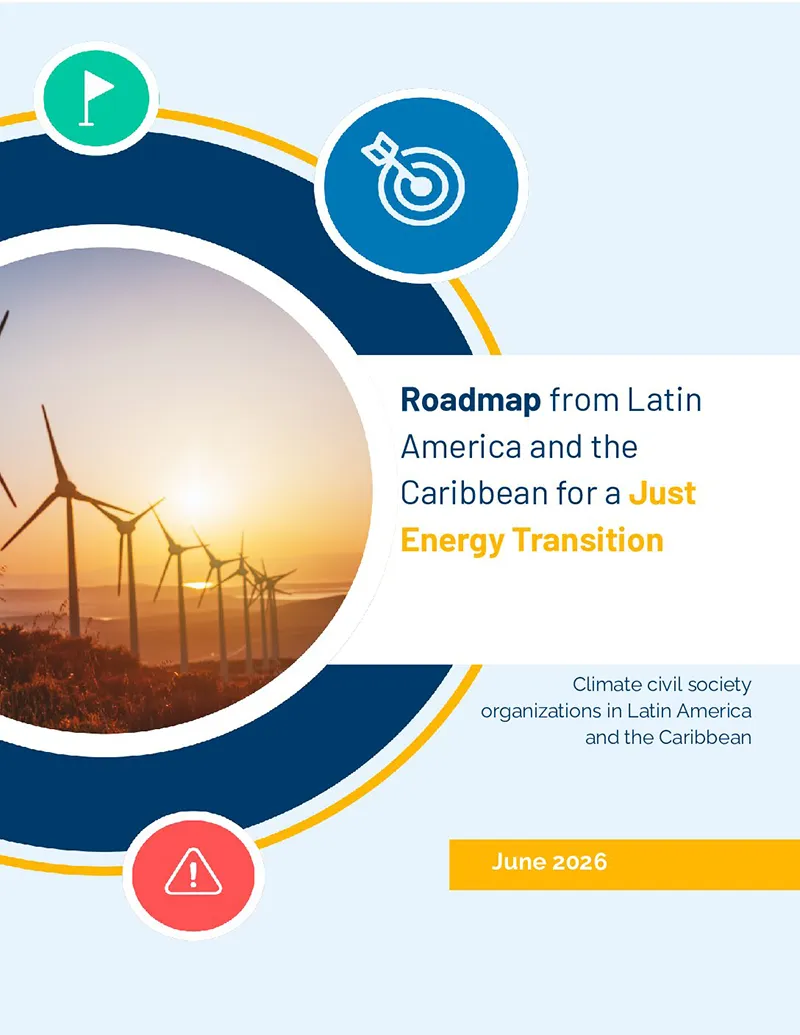
The just energy transition in Latin America and the Caribbean cannot be achieved simply by adding more renewable energy: it requires an orderly phase-out of fossil fuels coordinated with changes in the electricity system, demand, the productive structure, financing, and governance. The roadmap proposes this transformation as a sequence of goals, barriers, and actions through 2050, differentiated according to each country's energy, economic, and institutional conditions.
The proposal emerged from a process led by civil society organizations, regional networks, and experts, and is conceived as an implementation and advocacy tool. It recognizes Latin America and the Caribbean as a region that combines dependence on fossil fuels with high renewable energy potential, while also facing widely differing national pathways and gaps between climate commitments and decisions on production, infrastructure, consumption, and financing.
El punto central está en convertir las anteriores tensiones en una arquitectura de transición: reducir progresivamente la oferta fósil, modernizar e integrar los sistemas eléctricos, transformar la demanda, diversificar economías y empleos, y consolidar reglas de participación, protección territorial, transparencia y resiliencia. De esta manera se abre una discusión sobre qué acciones deben comenzar antes de 2030, qué transformaciones se requieren en la década siguiente y cuáles deben quedar consolidadas hacia 2050.
Key Recommendations
- Plan the fossil fuel phase-out from the supply side. Declinar progresivamente la producción de fósiles, restringir nuevos proyectos de exploración y explotación, cerrar o reconvertir infraestructura, transformar empresas estatales de hidrocarburos y controlar emisiones operacionales, con medidas diferenciadas según los perfiles energéticos nacionales.
- Prepare the electricity system to replace fossil fuel functions. Renewable expansion must be accompanied by storage, flexibility, smart grids, demand management, and regional interconnection, together with a greater share of distributed, community-based, and individual generation in installed capacity.
- Transform demand sector by sector. Industry, transport, and housing require different combinations of electrification, energy efficiency, and demand management, while hard-to-abate sectors need specific technological and material pathways to reduce their dependence on fossil fuels.
- Use the transition to diversify the economy. Industrialization and reindustrialization, regional value chains, the circular economy, workforce retraining, innovation, and technological capabilities need to be linked to new financing structures and a progressive reduction in dependence on fossil fuel revenues.
- Make justice a condition for implementation. Binding participation, free, prior, and informed consent, ecosystem protection and the rights of nature, climate risk integration, transparency, and accountability are part of the proposed architecture for sustaining the transition.
We believe that the transition will only be viable if it is built on the foundation of a just energy transition, one that acknowledges the varying degrees of dependence on fossil fuels, the different realities of each country, and the need to protect rights, ensure participation, and strengthen institutional capacities for the transition.
The starting point: a transition with uneven dependencies
In Latin America and the Caribbean, even though nearly 60% of electricity generation comes from renewable sources, around two-thirds of the regional energy mix depends on fossil fuels. Relatively clean electricity, therefore, does not mean the energy system has been decarbonized: transport, industry, hydrocarbon production, and fossil fuel infrastructure continue to shape the region's trajectory.
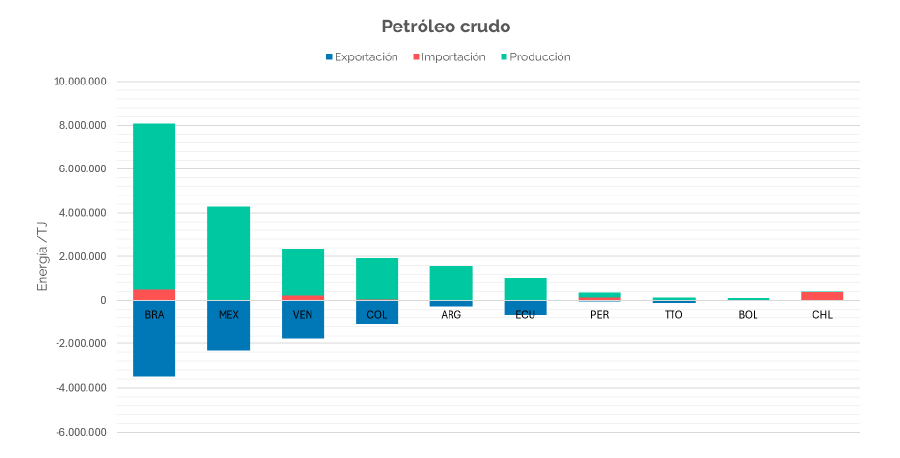
Dependence is not homogeneous either. Some countries maintain or seek to expand oil and gas production and exports; others have mature production and signs of slowing; and several import oil and petroleum products despite having refining capacity. These differences shape both the risks and the available choices: a country dependent on fossil fuel revenues does not face the same transition as one exposed to imports and international price volatility.
Three major challenges compound this heterogeneity. The first concerns supply reduction: transition scenarios have defined demand decline more clearly than the phase-out of exploration, production, refining, and infrastructure. The second is productive and fiscal: the region remains exposed to raw material exports, fossil fuel subsidies, public revenues linked to hydrocarbons, and financing constraints. The third is institutional and territorial: there are inequalities in energy access, differing public-sector capacities, and communities that may be exposed both to the impacts of fossil fuel phase-out and to those of new infrastructure.
This means that fossil fuel phase-out, renewable expansion, productive transformation, and rights protection must move forward as coordinated processes, adapted to different national and territorial conditions.
Turning fossil fuel phase-out into a planned transition
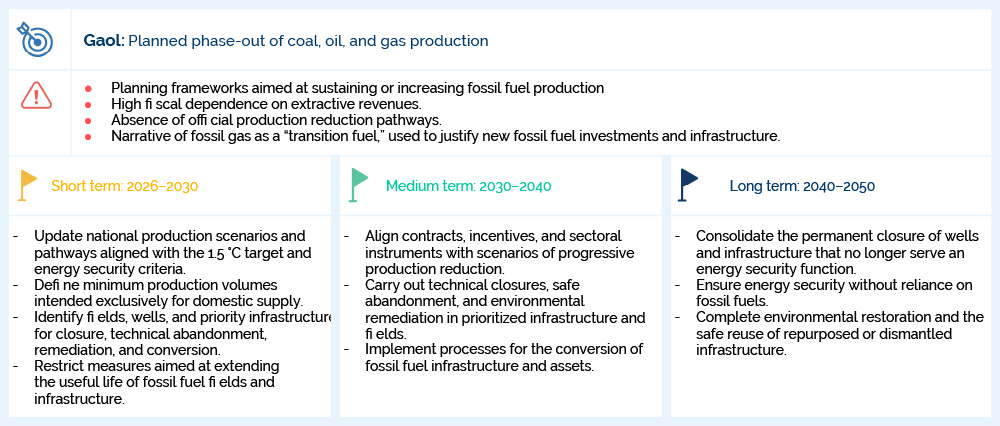
Para avanzar en una transición planificada, es necesario que entre 2026 y 2030 se actualicen trayectorias nacionales de producción, se identifiquen campos e infraestructura prioritarios para cierre y remediación, y se reduzcan incentivos a la expansión. Entre 2030 y 2040, el énfasis debe estar en ejecutar cierres, retirar mecanismos de expansión y fijar fechas para reconvertir infraestructura. Hacia 2050, el objetivo es consolidar el cierre de activos sin función de seguridad energética y completar restauraciones.
State-owned companies must also be brought into this process: mandates should be reformed, contracts reviewed, and technical capabilities and workforces redirected toward renewables, storage, and other activities compatible with the transition. Rather than treating the decline in fossil fuel supply in isolation, the proposal is for multi-year transition planning that provides stability and certainty.
Preparing electricity and demand to replace fossil fuels
The fossil fuel phase-out can only be sustained if the electricity system replaces the functions fossil fuels currently provide and demand changes at the same time. Achieving a highly decarbonized, diversified, and interconnected system before 2050 requires modernized grids, storage, flexibility, demand management, reduced losses, and the gradual retirement of fossil-fired thermal generation once its system services can be replaced.
Regional integration is a condition for this transformation. To achieve 100% electricity interconnection in Latin America by 2045 at the latest, joint regional energy planning, regulatory harmonization, and cross-border electricity trade must advance, alongside the development of high-capacity interconnection lines, among other measures.
In parallel, industry, transport, and housing require their own electrification and efficiency pathways. Cement, steel, aluminum, and fertilizers require specific pathways, while energy efficiency acts as a cross-cutting resource to contain demand and make better use of infrastructure.
Making diversification a condition of the transition
The energy transformation must also change what the region produces, how it creates jobs, and how it finances the transition. Industrialization and reindustrialization enable greater local and regional value added, the development of manufacturing linked to the transition, stronger circular economy practices and value chains, and reduced external technological dependence.
Workforce retraining is integrated through training, social protection, labor market reintegration, and dialogue among governments, companies, and workers' organizations, together with dedicated funds and regional monitoring. The territorial approach, in turn, helps identify regions vulnerable to fossil fuel phase-out and establish explicit targets for effective labor market integration.
Financing completes this architecture through stronger public and development banks, transition funds, international cooperation that does not deepen debt, and reforms to subsidies, royalties, and fiscal rules. Diversifying production and public revenues are therefore two necessary conditions for moving away from fossil fuel dependence.
Turning participatory governance and monitoring into rules for implementation
Implementation processes depend on rules that define who participates, which territories are protected, and how accountability for results is ensured. In that regard, binding participation, access to information, free, prior, and informed consent, and coordination between national and subnational governments are needed to integrate energy planning and land-use planning.
Other necessary implementation conditions include ecosystem protection and an adaptation approach. The former should include moratoriums and exclusion zones, recognition of the rights of nature, and safeguards for critical minerals. This must be accompanied by an adaptation approach that incorporates climate risk, resilience, and loss and damage into energy infrastructure and financing.
To make these conditions verifiable, the roadmap proposes permanent monitoring, reporting, and verification systems, public registries, climate and financial disclosure, and independent audits. It also proposes reviewing investor-state arbitration mechanisms to protect the regulatory space for fossil fuel phase-out policies. Governance and monitoring thus help define how the transition is planned, financed, authorized, and overseen.
A common pathway with differentiated trajectories
The transition in Latin America and the Caribbean must be recognized as multidimensional. Fossil fuel phase-out requires electricity systems capable of replacing its functions; electrification requires efficiency, grids, and demand management; and reducing extractive revenues requires new productive, labor, and fiscal foundations. The proposal therefore frames these as interdependent dimensions that must advance in a coordinated manner.
Estas múltiples dimensiones deben considerar además un criterio de planificación en el tiempo. Las decisiones de esta década —sobre expansión fósil, infraestructura, regulación, financiamiento, capacidades productivas y participación— condicionan lo que podrá ejecutarse entre 2030 y 2040 y consolidarse después.
A just energy transition thus emerges as a coordinated transformation of energy, the economy, and institutions, with climate justice as the criterion for deciding what is transformed, how benefits are distributed, and which limits must be respected. Differences among countries and territories do not eliminate the common horizon; they make it possible to translate it into pathways applicable to different realities.
Consult the full roadmap to explore in greater depth the goals, barriers, and proposed actions for each period, sector, and dimension of the just energy transition in Latin America and the Caribbean, with specific references to different countries in the region.
Methodology or scope
The roadmap is presented as a living document developed through working groups and combines technical analysis, inputs developed through collaborative discussion, and participatory spaces. It organizes each set of goals around barriers, immediate actions through 2030, medium-term measures between 2030 and 2040, and consolidation between 2040 and 2050. In the chapters on fossil fuel phase-out and diversification, measures are differentiated by country profiles; in governance, they are organized by lines of institutional and regulatory transformation. This structure is intended to serve as a reference that can be adapted to different national and territorial contexts.
Source
Climate civil society organizations in Latin America and the Caribbean. (2026, June). Roadmap from Latin America and the Caribbean for a Just Energy Transition.
Ordering the phase-out of fossil fuels requires far more than setting a decarbonization target: it requires coordinating decisions on supply, demand, infrastructure, employment, the economy, and governance according to each country's realities. This comprehensive perspective directly aligns with Transforma's programmatic priority of a “Just Energy Transition.”

Conditions for translating the transition into decisions
Under Transforma's programmatic priority of a “Just Energy Transition,” the roadmap frames implementation as a process that must coordinate fossil fuel phase-out with the transformations needed to replace it and address its economic, labor, and territorial implications.
- Plan the phase-out of fossil fuels from the supply side, defining how to reduce production, restrict new expansion, and repurpose or close infrastructure according to each national context.
- Support fossil fuel substitution with grids, storage, interconnection, decentralized generation, and demand transformation to sustain a highly decarbonized electricity system before 2050.
- Link productive diversification and workforce retraining with social protection, training, and territorial participation, especially in regions and among workers exposed to the decline of fossil fuel activities.
Advancing these conditions can help Latin America and the Caribbean reduce its dependence on fossil fuels without separating the energy transformation from its productive, labor, and territorial dimensions.