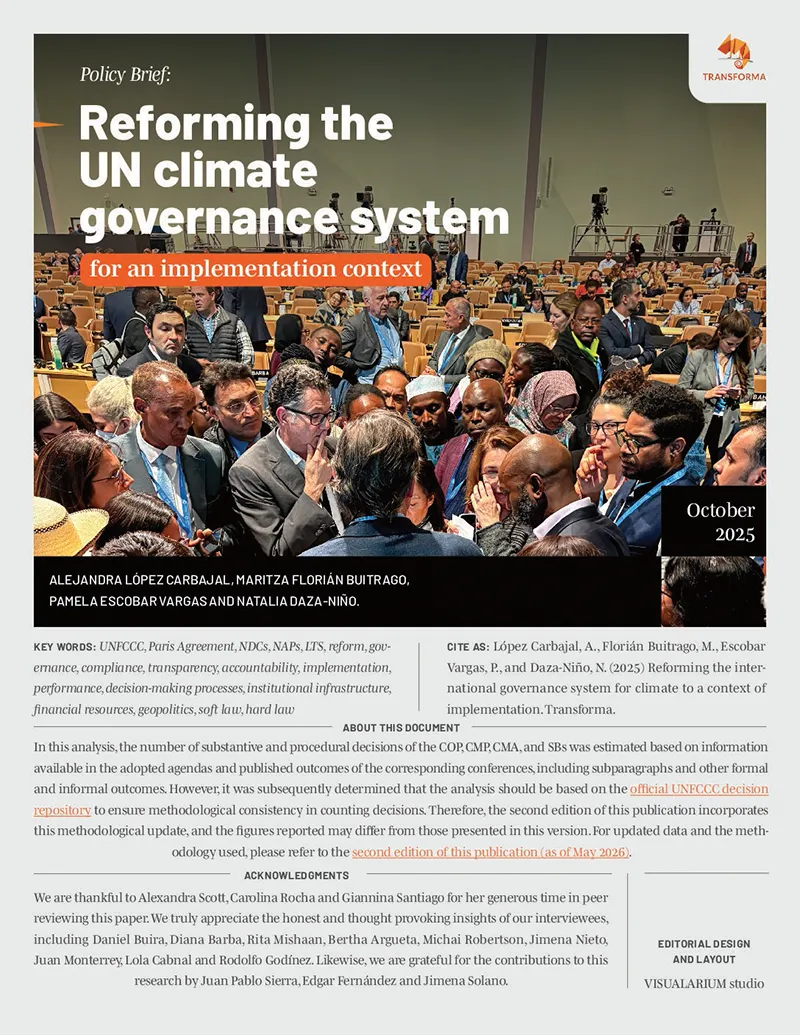
The United Nations climate regime faces a pivotal transition: moving beyond agreeing on rules to ensuring that Paris Agreement commitments are implemented and their progress can be assessed. Although the Paris Agreement rulebook is complete, negotiations remain burdened by procedural work, bodies with partially overlapping mandates, and monitoring mechanisms that need strengthening. Reforming the system means improving its ability to guide concrete action, rather than simply producing more decisions.
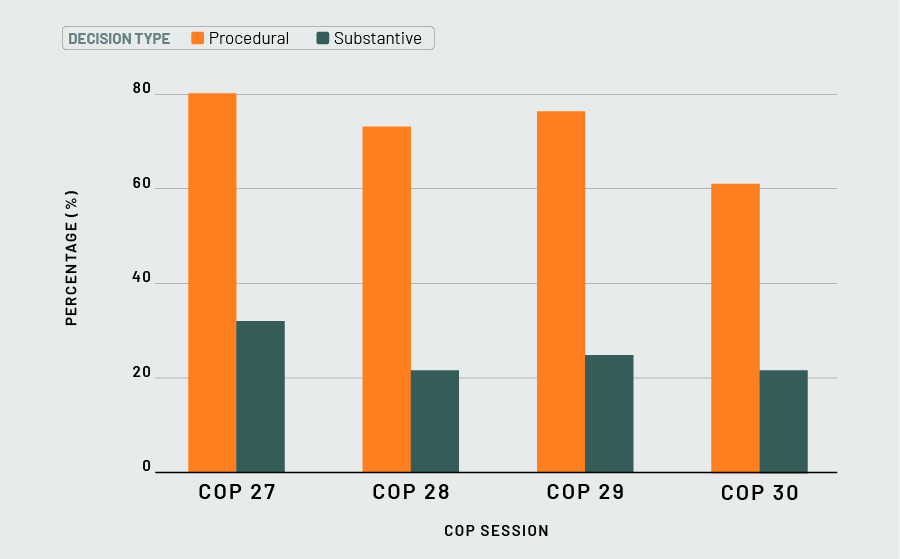
This policy brief published by Transforma examines the regime’s institutional architecture and the outcomes of negotiations from 2022 to 2025, alongside interviews with members of its bodies. The review classifies 74% of the decisions and conclusions assessed as procedural, compared with 26% that were substantive. This raises the question of how decision-making processes should be reshaped in the years ahead, with greater emphasis on transparency, climate finance, compliance and the Global Stocktake.
The proposed reform combines near-term adjustments in the lead-up to COP31 and the second Global Stocktake—the collective assessment of progress under the Paris Agreement—with more far-reaching institutional reforms. The priority is to connect implementation initiatives with national commitments, financial resources and accountability mechanisms, so that new avenues for action do not operate separately from the Agreement.
Key Recommendations
The recommendations highlight the following complementary priorities for adapting climate governance to the implementation phase:
- Shift from negotiation to implementation. Refocus the UN climate regime’s institutional architecture, currently centred exclusively on rulemaking, towards ensuring implementation, transparency, cooperation and accountability under the Paris Agreement; and assess how new platforms, such as the GIA and the Belém Mission to 1.5°C, can strengthen the link to implementation.
- Focus negotiations on substantive issues. Streamlining agendas through multi-year planning and reviewing the frequency and format of conferences would free up more time for transparency, finance, compliance and the Global Stocktake, as a core part of the Agreement’s ambition mechanism to drive an upward spiral of increased action.
- Review the institutional architecture. Assessing the mandates of constituted bodies and potential overlaps, including the legacy of the Kyoto Protocol—a treaty that established binding emissions-reduction commitments for certain developed countries—would help prioritise implementation functions. Stronger coordination, technical assistance and institutional monitoring are also proposed.
- Link complementary initiatives to the Paris Agreement. Mechanisms launched in the wake of COP30, coalitions and roadmaps need to be connected to national contributions, transparency reports, finance and the Global Stocktake, with clear responsibilities and reporting channels.
This moment offers a renewed opportunity to transform a negotiation-centered process into a delivery architecture capable of safeguarding the Paris Agreement and translating its promises into real-world action.
A streamlined agenda for more substantive decisions
Negotiations continue to devote resources to timetables, reports and deferred items that maintain administrative continuity but do not always provide new policy guidance. This assessment does not dismiss their value; rather, it suggests that, with the rulemaking phase complete, the allocation of negotiating time should reflect a different set of priorities.
COP31 is presented as an opportunity to pilot multi-year programme planning: consolidating related agenda items, managing speaking time more effectively, and assessing which matters require annual consideration and which could be addressed less frequently. Adopting clear rules of procedure and voting would also seek to overcome deadlocks when consensus cannot be reached. These are proposals for Parties to consider, not reforms that have already been adopted.
Institutions equipped to coordinate and deliver
Constituted bodies provide technical expertise and support capacity-building, but the interviews identify insufficient coordination, budget constraints and weaknesses in oversight. To ensure that their work contributes more directly to the fulfilment of commitments, the brief proposes reviewing their mandates and establishing stronger coordination and evaluation mechanisms.
The review would cover structures inherited from the Kyoto Protocol and a more active role for the secretariat of the United Nations Framework Convention on Climate Change (UNFCCC) in supporting the preparation and implementation of nationally determined contributions, adaptation plans and long-term strategies. The aim would not be to retain or abolish bodies automatically, but to determine which should be strengthened, transformed or closed, depending on their value for implementation.
Connecting political initiatives to verifiable commitments
COP30 brought greater visibility to platforms and roadmaps intended to implement agreements, but their proliferation could also fragment responsibilities. The proposed bridge towards COP31 and the second Global Stocktake links the Action Agenda, the Global Implementation Accelerator and other initiatives to the Paris Agreement’s formal instruments: nationally determined contributions, national adaptation plans, biennial transparency reports and climate finance.
Strengthening those links requires milestones, reporting channels and continuity across COP presidencies. Coalitions can complement multilateral negotiations, provided that their progress feeds back into the formal process and can be assessed against standards of transparency, equity and accountability.
Reform does not depend on a single institution, nor does it require moving every decision outside the Convention. The proposal is to act on two complementary fronts: improving mandates and procedures within the regime, while linking delivery initiatives to public commitments. As COP31 and the second Global Stocktake approach, the credibility of this transition will depend on continuity, clearly assigned responsibilities and monitoring that makes it possible to identify progress and implementation gaps, particularly for the most vulnerable countries.
Read the full policy brief for a deeper examination of the institutional assessment, the ten recommendations and the two proposed pathways for reforming implementation of the Paris Agreement.
Source
López Carbajal, A., Florián Buitrago, M., Escobar Vargas, P., & Daza-Niño, N. (2026). Reforming the UN climate governance system for an implementation context (2nd ed.). Transforma.
Climate governance reforms are not only about streamlining negotiations: they also concern how decisions are sustained, who is accountable for their implementation, and how progress is assessed. This debate is relevant to Transforma’s programmatic priority of ‘Latin American leadership and influence’.

Climate influence also depends on the rules of the system
For Transforma’s programmatic priority of ‘Latin American leadership and influence’, participating in negotiations is not enough: multilateral processes must also make it possible to adopt decisions and sustain them over time. With that in mind, the study proposes, among others, the following courses of action:
- Pilot multi-year planning: COP31 could serve as a test case for planning that simplifies negotiations and prioritises transparency, climate finance, compliance and the Global Stocktake.
- Adopt formal voting rules: Parties could agree on procedures to prevent the absence of consensus from blocking future climate decisions.
- Link initiatives to the Paris Agreement: COP presidencies and initiative leads should connect them to national commitments, finance and transparency reporting.
Progress on these reforms could give the region better conditions to influence multilateral climate decisions, promoting more transparent and equitable implementation with clear lines of responsibility.