Ahead of COP31, the co-presidency of Turkey and Australia is proposing a voluntary commitment to have electricity account for 35% of global final energy consumption by 2035.In Colombia, that share stood at 18% in 2024, according to the International Energy Agency (IEA)..
Meanwhile, in Latin America and the Caribbean, nearly two-thirds of the energy mix continues to depend on fossil fuels, according to the LAC Roadmap, although 64.3% of its electricity is already renewable, according to (OLACDE, 2025).
The opportunity lies in end uses—that is, the energy we consume for transportation, cooking, heating water, and producing goods. Today, oil accounts for nearly 90% of the energy used by Colombia’s transportation sector, and coal accounts for about 40% of the energy consumed by industry. In buildings, electricity already accounts for 40% of energy consumption.
Electrifying these uses can reduce dependence on fossil fuels, but it is not enough. Colombia needs to identify which barriers it must overcome in each sector, how to reduce consumption through energy efficiency measures, and how to meet the new demand with an increasingly renewable electricity supply.
Transportation: progress where public goals exist
Transportation is one of the main areas of opportunity for electrification. In Latin America and the Caribbean, oil accounts for nearly 86% of transportation energy, according to IEA data compiled in the LAC Roadmap. Reducing that figure depends on the pace at which vehicles are electrified and public transportation is strengthened.
In Colombia, according to Transforma’s model for the transportation sector, the vehicle fleet—excluding motorcycles—is projected to grow by about 56% between 2025 and 2050. The decisions made regarding the replacement of these vehicles will shape their energy consumption for decades to come.
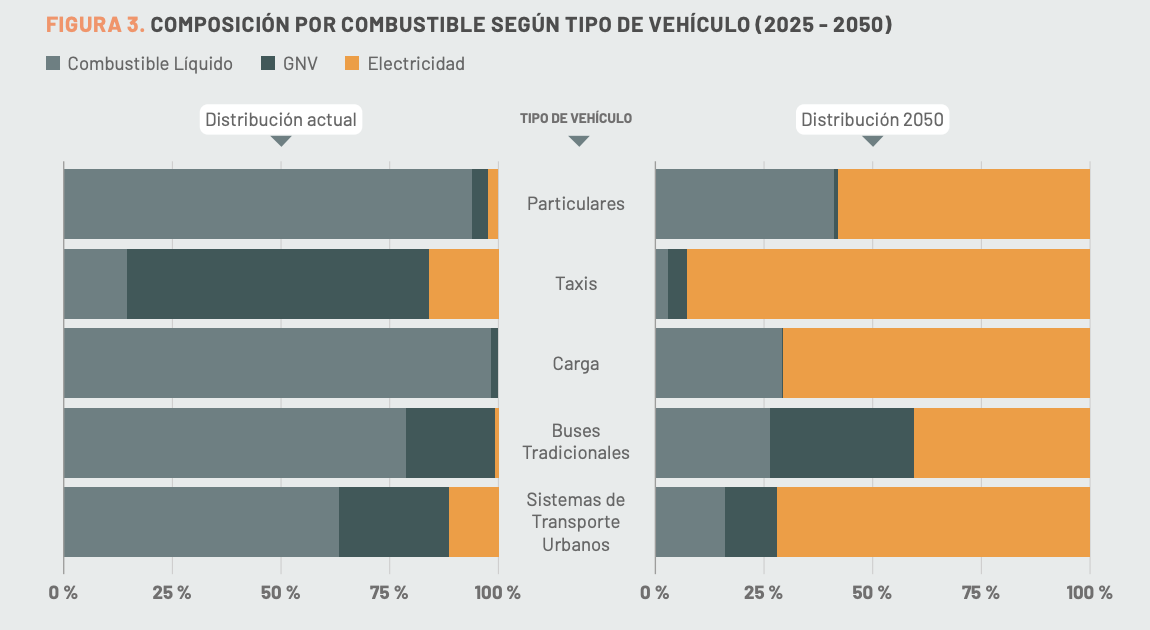
The analysis reveals a clear pattern: where there is explicit public policy guidance toward zero-emission technologies, electrification advances more quickly; where decisions are fragmented and respond to short-term economic signals, gasoline use may even increase.
Taxis, which have economic incentives to switch, travel many kilometers a day, so operating costs may favor electric vehicles. In integrated systems, such as TransMilenio, MIO, and Metroplús, buses travel longer distances, operate under structured contracts, and typically have public electrification targets. Bogotá, for example, already has 1,500 electric buses, according to the IEA..
Traditional buses represent the other side of the coin. In this case, replacement decisions are more scattered and depend on immediate costs. Without clear support policies, the model estimates that the number of gas-powered buses will increase through 2050.
The lesson aligns with that of the region: the LAC Roadmap Figure 3 from the transportation study: fuel composition by vehicle type, today and in 2050 (Transforma, p. 3).
To achieve this, clear public policies, charging infrastructure, economic incentives that favor electric technologies, funding to renew fleets, scrappage programs, and support for national electric mobility value chains are needed.
Read the full study: Demand-Side Sector Analysis in Colombia: Gas Transition Scenarios in the Transportation Sector.
Households: electric heaters gain ground, while stoves lagging behind
In households, stoves and water heaters show that not all end uses face the same barriers or are advancing at the same pace. In 2018, 64.2% of Colombian households cooked with piped gas, while only 2.4% used electricity, according to DANE.
The Transforma model projects that by 2035, more new electric stoves will be purchased than gas stoves. Even so, by 2050, electric stoves would account for only 45% of all stoves in the country. For water heaters, the transition would be faster, with electric models accounting for over 80% of new purchases in that same year.
The difference lies in the upfront costs. Electrifying a kitchen requires electrical upgrades and new appliances, while replacing a water heater involves fewer modifications. This is a barrier common throughout the region, although the LAC Roadmap notes that households are the sector that can be electrified most quickly, particularly in cooking and heating.
Unlocking the energy transition in Colombia: Strategies to reduce gas dependency
Related study: Gas Transition Scenarios in the Residential Sector — Transforma..
In short, to accelerate electrification in homes, we need more accessible electrical appliances—with lower prices or financing options—as well as local technical service and up-to-date energy labeling.
Industry: electrify where the technology already exists
In industry, opportunities depend on the energy needs and possibilities of each process. In Latin America and the Caribbean, industry would phase out fossil fuels more slowly than other sectors. Its share of industrial energy would drop from about 50% to 30% by 2050To scale up electrification, the Roadmap notes that industry needs reliable renewable electricity, grid capacity, and rates that support its competitiveness.
For Colombia, the IEA’s scenario projects that industrial production would nearly double by 2050 and that electricity would become the sector’s primary energy source.
Not all processes have the same alternatives. According to Ember y Transformaactivities requiring very high temperatures—such as the production of cement, lime, glass, and steel—may continue to rely on natural gas in the short and medium term, while electric and hybrid solutions mature. The priority lies with processes that can already be electrified using available technologies, without losing sight of those that still face technical barriers.
Planning electricity demand and generation simultaneously
Electrifying transportation, homes, and industry will increase the demand for electricity. For this shift to lead to sustained reductions in emissions, power generation must become increasingly renewable, and the electric grid must be prepared to respond.
Over the past decade, nearly two-thirds of Colombia’s electricity came from hydroelectric power, according to the IEA.However, the share of this source can vary by up to ten percentage points from year to year, depending on phenomena such as El Niño and La Niña. In El Niño years, such as 2015 and 2024, thermal power plants consumed up to one-third of the country’s natural gas. las plantas térmicas llegaron a consumir hasta un tercio del gas del país.
If electrification proceeds without sufficient renewable generation, storage, grid infrastructure, and flexibility, part of the new demand could be met with additional gas-fired generation. In that case, the shift to new technologies in end-use sectors would not realize its full potential for reducing emissions.
Colombia is not an isolated case; the LAC Roadmap warns that systems reliant on hydropower must diversify to reduce their exposure to droughts.
Therefore, electrification must link two transformations: electrifying end uses that currently depend on fossil fuels and developing the infrastructure needed to supply increasingly renewable electricity. Both must go hand in hand with policies promoting energy conservation and efficient use, which will reduce the demand that the electric system will have to meet.
The opportunity lies in how we electrify
The “35 by 35” proposal, put forward by the COP31 presidency,sets out a global ambition. In Colombia, moving toward this goal requires concrete decisions in transportation, households, industry, and the electricity grid, taking into account the barriers and opportunities in each sector.
Electrifying end uses in a planned manner and accompanying that change with an increasingly renewable electricity generation mix would allow the country to reduce its dependence on fossil fuels, limit its exposure to gas imports, and lower its emissions without shifting the problem from one sector to another.
For Latin America and the Caribbean, the viability of electrification depends on the prior and sustained decarbonization of the electricity system. Planning electrification sector by sector is what can translate that advantage into reduced use of fossil fuels.